%20(2).png)
.png)
.jpg)


What does it mean to live in relationship with a world that is alive?
For six months, we will slowly journey through Robin Wall Kimmerer’s Braiding Sweetgrass, gathering in council twice each month to explore the meeting place between Indigenous knowledge, botany, ecology, reciprocity, and our own lived relationships with the natural world.
Rather than moving quickly through the book, we will allow its teachings to accompany us through a season, from September toward the closing of the Maya year and the threshold of a new cycle.
Reading becomes a practice of attention.
We will read, spend time observing the landscapes where we live, and return to council with our questions, experiences, passages that stayed with us, and what we are beginning to perceive differently.
About the Book
Published in 2013, Braiding Sweetgrass: Indigenous Wisdom, Scientific Knowledge, and the Teachings of Plants brings together Robin Wall Kimmerer’s work as a botanist, educator, writer, and enrolled member of the Citizen Potawatomi Nation.
Throughout the book, Kimmerer moves between scientific inquiry, Potawatomi teachings, personal and family stories, ecological restoration, and sustained observation of plants and landscapes.
Sweetgrass becomes both teacher and structure.
The book moves through five sections:
-
Planting Sweetgrass
-
Tending Sweetgrass
-
Picking Sweetgrass
-
Braiding Sweetgrass
-
Burning Sweetgrass
Across these movements, Kimmerer asks us to consider how we come to know the living world and what responsibilities arise from that knowledge.
We encounter questions of gratitude and gift, the grammar of animacy, plants as teachers, land and belonging, the Honorable Harvest, restoration, consumption, reciprocity, and ultimately what it means to return the gift.

Meet your Guides

Mariana Bandera
Mariana is the founder of Passages, a living Earth School dedicated to bridging ancestral wisdom with contemporary life. Her work is an offering to culture, ceremony, and the sacred connections that unite humanity across generations.
Our Wisdom Keepers
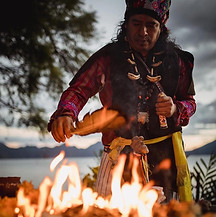
Tata Thomas
Walther Thomas Mendoza Cholotio is a Tz’utujil Maya spiritual guide (Ajq’ij) from San Juan La Laguna, Sololá, Guatemala. Descended from generations of healers and spiritual guides, he was raised within the ceremonial traditions, prophecies, and healing practices of his ancestors. Today, he carries forward this lineage with devotion and service, sharing Maya ancestral wisdom through ceremony, timekeeping, and spiritual guidance. He is also an acupuncturist and practitioner of holistic health, working with medicinal plants and alternative healing modalities.

Unle Kirk
Uncle Kirk is a Diné elder who has devoted much of his life to walking and sharing the Holy Path through peyote and teepee ceremonies within his community and with communities around the world. Rooted in the teachings of peace, harmony, and right relationship, he offers guidance through story, prayer, and lived wisdom. Through his encouraging presence and teachings, participants are invited to deepen their understanding of what it means to live in balance with oneself, with others, and with the living world from a Diné perspective.

Nana Jessica & Tata Jerico
Nana Jessica and Tata Jerico are wisdom keepers from the K’iche’ Maya lineage, rooted in San Juan Sololá, where they serve as respected teachers and pillars of their community. Working in partnership, they carry ancestral knowledge of the Cholq’ij—the sacred Maya calendrical system—and its teachings on the nawales, ceremonial time, and relational cosmology. Their work is deeply grounded in the ancestral use of cacao and corn as living medicines that sustain life, memory, and community continuity.

Study Overview

SEPTEMBER
Beginning with Gift
We begin with Skywoman Falling and the opening essays of Planting Sweetgrass, entering Kimmerer’s questions around creation, belonging, gratitude, gift, and reciprocity.
We begin noticing the assumptions we carry about the relationship between humans and the living world.
Guiding questions
What does it mean to live in relationship with a world that is alive?
What changes when we understand the world as gift?
How do the stories we inherit shape our relationship with land?
How do we receive a gift?
SEPTEMBER
PLANTING SWEETGRASS
October
Learning to Pay Attention
We continue through Planting Sweetgrass and enter Tending Sweetgrass, where relationship becomes something practiced through attention, care, language, seasonality, and observation.
We begin examining how knowledge is formed through sustained relationship with place.
Guiding questions
How do we come to know the living world?
What can sustained attention teach us?
What relationships become visible when we learn how to pay attention?
What changes when plants become teachers rather than background?


NOVEMBER
TENDING SWEETGRASS
Language, Personhood & Ways of Knowing
Through essays including Learning the Grammar of Animacy, we enter questions of language, perception, personhood, and the meeting of different ways of knowing.
We consider how the words we use influence what we are capable of recognizing as alive.
Guiding questions
How does language shape what we are capable of perceiving?
What happens when another living being is encountered as a subject rather than an object?
How is ecological knowledge formed and carried?
How can different ways of knowing enter into relationship while retaining their differences?
DECEMBER
PICKING SWEETGRASS
The Honorable Harvest
As we enter Picking Sweetgrass, our attention moves toward receiving, harvesting, responsibility, and the ethics of taking from the living world.
The Honorable Harvest gives us a framework through which to examine food, plants, consumption, abundance, restraint, and reciprocity.
Guiding questions
What does an Honorable Harvest ask of us?
What responsibilities accompany receiving?
What distinguishes reciprocity from transaction?
How might we learn to recognize enough?
What does relationship ask of us when we take?


JANUARY
BRAIDING SWEETGRASS
Restoration, Memory & Repair
Braiding brings different strands into relationship.
Through Kimmerer’s writing on restoration, land, ecological memory, loss, and responsibility, we ask what it means to participate in the repair of relationships that have been damaged.
We begin bringing together what we have learned through reading with what our own landscapes have taught us.
Guiding questions
What does ecological restoration actually restore?
How does a landscape carry memory?
What is our responsibility toward places we did not personally damage?
What becomes possible when knowledge is brought into relationship rather than held separately?
How might restoration also transform the person participating in it?
FEBRUARY
BURNING SWEETGRASS
Returning the Gift
Our final movement brings us into Kimmerer’s writing on extraction, consumption, abundance, Windigo, responsibility, and regeneration.
As we approach the threshold of the Maya New Year, we turn toward integration.
We ask what these six months have changed in the ways we perceive our own landscapes—and what we now understand ourselves to be responsible for.
Guiding questions
What does it mean to return the gift?
What happens when consumption becomes disconnected from relationship?
How do we participate in abundance without exhausting its source?
What relationships require our attention now?
.jpeg)

